
Ethyl Acetate 99.9%
 Download
If Ethyl Acetate is only a line item, you pay for it later in defects. Blush in humid weather, slower drying, solvent balance drift, or solvent recovery that suddenly struggles. Our Ethyl Acetate 99.9% is supplied with tight consistency, documentation support that clears procurement and QA, and dependable supply planning for 210 kg drums, built around safer sourcing practices that reduce handling surprises at the site, backed by Chemical Exporters in India.
About Ethyl Acetate 99.9%
Ethyl Acetate is a widely used solvent where operations prefer quick evaporation and a clean finish across repeat runs. Many plants choose it because it blends well in solvent systems and supports consistent processing, especially where small solvent variations can affect drying, appearance, or downstream performance.
Hazard Symbols


Product Specifications
| TEST | SPECIFICATION |
|---|---|
| Appearance | Colorless liquid |
| Odor | Sweet characteristic |
| Assay | 99.9% as supplied |
| Boiling Point | 77.11°C |
| Freezing Point | Minus 83.97°C |
| Flash Point | Minus 4°C, closed cup |
| Density | 0.9006 g per mL at 20°C |
| Vapor Pressure | 73.0 Torr at 20°C |
| Viscosity | 0.45 cP at 20°C |
| Water Solubility | About 8.7% at 20°C |
Available Packaging
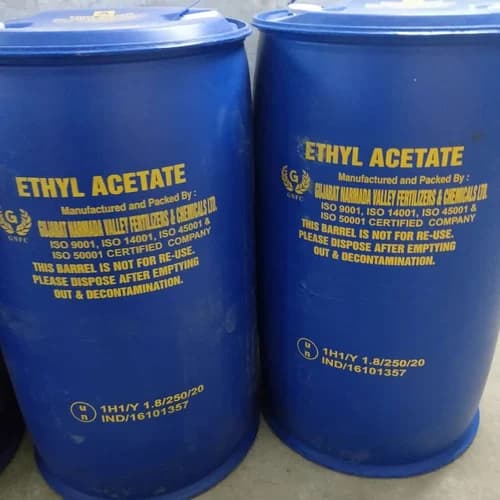
- ♦210 kg intact barrel packing
Applications
Paint, Ink & Coatings
- ♦Ethyl Acetate is used for solvency and fast drying in coatings and ink systems where evaporation rate, water tolerance, and low residue protect clarity, gloss, and defect control. Plants often validate with their resin package because small water shifts can change blush risk and drying balance.
Pharma
- ♦Ethyl Acetate is used as a process solvent and cleaning solvent where residue control, water content, and trace acidity impact intermediate quality and solvent recovery performance. Pharma buyers typically lock COA lines and test methods early, so inward release and batch documentation move smoothly.
Safety & Handling
- ♦Ethyl Acetate is a highly flammable solvent.
- ♦Use closed transfer, grounding, and good ventilation.
- ♦Keep away from ignition sources.
- ♦Follow the SDS for vapour exposure controls and emergency response.
Hazard Symbols
FAQ's
Frequently Asked Questions
Common Questions About Reaching Us
