
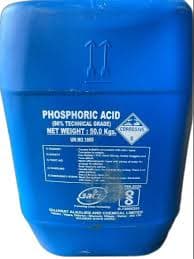
Phosphoric Acid 85 % (GACL / NIRMA)
 Download
Phosphoric Acid 85% is bought when plants need dependable acidity, consistent concentration, and paperwork that supports internal approvals without delay. If you are comparing Chemical Suppliers in India or Chemical Exporters in India, focus on concentration control, clarity for food and process use, and whether COA and MSDS can be shared during quotation as per your checklist. Get a Quote to confirm today’s price and availability.
About Phosphoric Acid 85 % (GACL / NIRMA)
Phosphoric Acid 85 % is a concentrated inorganic acid used for pH control, cleaning, and process conditioning where repeatable acidity impacts results. The 85 % grade matters because it influences dosing accuracy, storage efficiency, and how your process behaves batch to batch. Buyers typically evaluate concentration, appearance, impurity sensitivity for their application, and documentation readiness. COA, MSDS, and specification details can be shared on request during quotation, subject to availability.
Hazard Symbols

Product Specifications
| TEST | SPECIFICATION |
|---|---|
| Appearance | Water white liquid, colourless, odourless, typical, confirmed in COA during quotation |
| Specific gravity | Typical 1.686 to 1.692 at 25 to 15.5°C |
| Density 25°C | Typical about 1.68 to 1.69 g per cm3, batch value confirmed in COA during quotation |
| pH | About 1 for 75 to 85% solution, typical, confirm during quotation as per buyer method |
| Melting point | About 21°C, typical |
| Boiling point | About 158°C, typical for 85% grade |
| Viscosity | Typical about 43.5 cP at 25°C |
| Colour APHA | Typical 10 max |
| Chloride as Cl | Typical 25 ppm max |
| Packaging | 50 kg carbo packing |
| Documentation | COA and MSDS shared during quotation on request, subject to availability |
Available Packaging
- ♦50 kg carbo packing
Applications
Food Ind
- ♦Used where controlled acidity supports process adjustment and cleaning steps. Procurement and QA teams typically focus on concentration consistency, clarity of documentation, and impurity expectations aligned to internal standards. Suitability for your specific use is confirmed during quotation as per the buyer's specification.
Textile
- ♦Used for pH adjustment and process conditioning, where stable acidity supports repeatable outcomes and reduced rework. Teams often care about colour impact risk, consistency across lots, and compatibility with existing process chemistry. Acceptance limits can be aligned during quotation, subject to availability.
Sugar Mills
- ♦Used for pH control and process support, where stable acidity helps maintain operational consistency. Procurement teams usually evaluate concentration, handling practicality, and how the product aligns with their process and cleaning routines. Details can be confirmed during quotation as per the buyer's specification.
Safety & Handling
- ♦Phosphoric Acid is corrosive and can cause serious eye damage and skin burns.
- ♦Use site-approved PPE such as gloves, eye protection, and face protection where splash risk exists.
- ♦Store tightly closed in a cool, well-managed area with secondary containment and away from incompatible chemicals such as strong alkalis.
- ♦Spill response should follow site EHS procedures and the MSDS for the supplied batch.
Hazard Symbols
FAQ's
Frequently Asked Questions
Common Questions About Reaching Us
